openssl req
Creates certificate signing requests (CSR) for a CA, or self-signed certificates for internal use.
Syntax
openssl req -new -key KEY -out CSR [OPTIONS]
openssl req -x509 -newkey ALG -keyout KEY -out CERT [OPTIONS]
Options
| Option | Description |
|---|---|
-new -key FILE |
Create a CSR for an existing key |
-x509 |
Create a self-signed certificate instead of a CSR |
-newkey ec -pkeyopt ec_paramgen_curve:P-256 |
Create a new key at the same time |
-nodes |
Don't protect the new key with a password (needed for services) |
-subj "/CN=NAME" |
Subject without questions |
-addext "subjectAltName=DNS:..." |
Host names; clients only check the SAN, not the CN |
-days N |
Validity of a self-signed certificate |
-in CSR -noout -text |
Show a CSR |
Examples
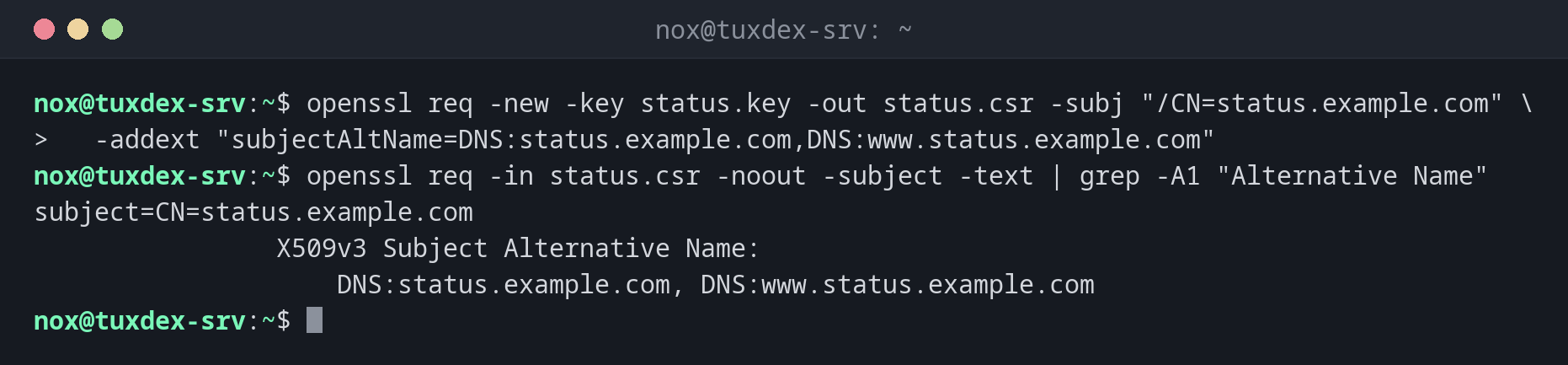
A CSR for an existing key:
openssl req -new -key status.key -out status.csr -subj "/CN=status.example.com" \
  -addext "subjectAltName=DNS:status.example.com,DNS:www.status.example.com"
openssl req -in status.csr -noout -subject -text | grep -A1 "Alternative Name"
subject=CN=status.example.com
                X509v3 Subject Alternative Name:
                    DNS:status.example.com, DNS:www.status.example.com
A self-signed certificate for an internal service:
openssl req -x509 -newkey ec -pkeyopt ec_paramgen_curve:P-256 -nodes \
  -keyout monitor.key -out monitor.crt -days 365 \
  -subj "/CN=monitor.internal.example.com" \
  -addext "subjectAltName=DNS:monitor.internal.example.com"
openssl x509 -in monitor.crt -noout -subject -issuer -dates
-----
subject=CN=monitor.internal.example.com
issuer=CN=monitor.internal.example.com
notBefore=Oct 26 09:42:17 2026 GMT
notAfter=Oct 26 09:42:17 2027 GMT
Subject and issuer are the same: that's what makes a certificate self-signed.
The content of a CSR:
openssl req -in status.csr -noout -text | head -8
Certificate Request:
    Data:
        Version: 1 (0x0)
        Subject: CN=status.example.com
        Subject Public Key Info:
            Public Key Algorithm: id-ecPublicKey
                Public-Key: (256 bit)
                pub:
When do I need it?
- To request a certificate from a commercial CA or an internal company CA
- For internal services that only your own machines use, with a self-signed certificate
- To check what a CSR contains before sending it
Always set subjectAltName
Browsers and current tools ignore the CN and only check subjectAltName. A certificate
without it is rejected, even if the CN is correct.
Self-signed means: nobody trusts it
Clients reject a self-signed certificate until it, or your own CA, is installed as trusted, see the basics. For anything public, use Let's Encrypt.