ansible-config
Shows which Ansible settings apply, where they come from, and creates a template for ansible.cfg.
Syntax
ansible-config view | dump [--only-changed] | list | init [--disabled]
Options
| Option | Description |
|---|---|
view |
Show the active configuration file |
dump |
Show every setting with its current value |
dump --only-changed |
Only settings that differ from the default, with their source |
list |
All settings with description, default and environment variable |
init --disabled |
Print a complete ansible.cfg with every setting commented out |
-c FILE |
Use this configuration file |
Ansible uses the first file it finds: $ANSIBLE_CONFIG, then ansible.cfg in the current directory, then ~/.ansible.cfg, then /etc/ansible/ansible.cfg.
Examples
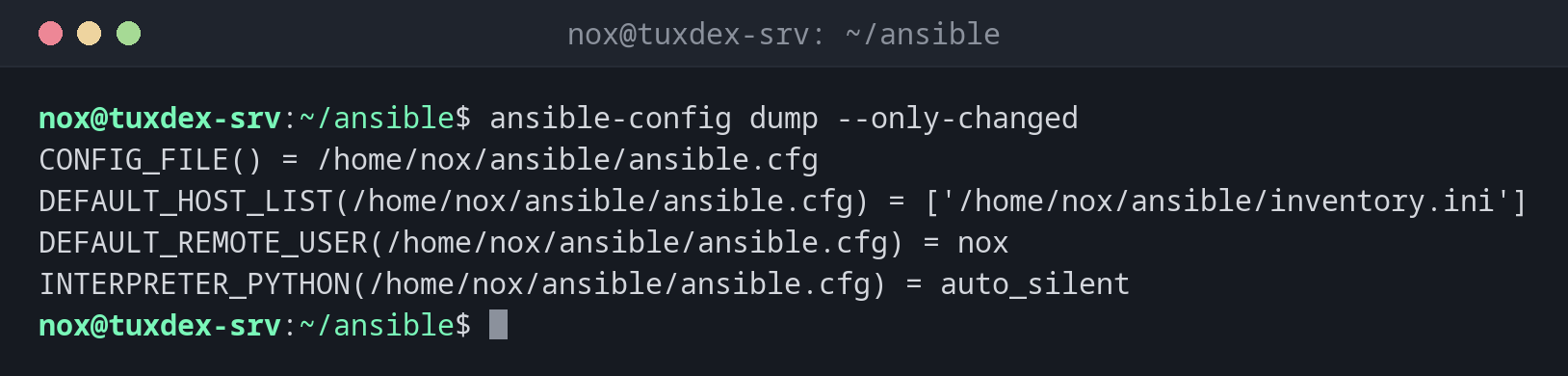
Show the settings that differ from the default:
ansible-config dump --only-changed
CONFIG_FILE() = /home/nox/ansible/ansible.cfg
DEFAULT_HOST_LIST(/home/nox/ansible/ansible.cfg) = ['/home/nox/ansible/inventory.ini']
DEFAULT_REMOTE_USER(/home/nox/ansible/ansible.cfg) = nox
INTERPRETER_PYTHON(/home/nox/ansible/ansible.cfg) = auto_silent
In brackets is the source of each value: here the ansible.cfg of the project.
The active configuration file:
ansible-config view
[defaults]
inventory = inventory.ini
remote_user = nox
interpreter_python = auto_silent
Version and configuration file:
ansible --version | head -3
ansible [core 2.19.11]
  config file = /home/nox/ansible/ansible.cfg
  configured module search path = ['/home/nox/.ansible/plugins/modules', '/usr/share/ansible/plugins/modules']
A template with every setting:
ansible-config init --disabled > ansible.cfg.example
grep -A2 '^# (integer) Maximum number of forks' ansible.cfg.example
# (integer) Maximum number of forks Ansible will use to execute tasks on target hosts.
;forks=5
When do I need it?
- To check why Ansible behaves differently in one directory than in another
- To start a new project with a documented
ansible.cfg - To find the name of a setting or its environment variable
ansible --version shows the file
The second line of ansible --version shows which configuration file is active, or
config file = None if there is none.
ansible.cfg in a world-writable directory
Ansible ignores an ansible.cfg in a directory that anyone can write to, such as
/tmp, and prints a warning. Keep projects in your home directory.